Lectures Enrich Us. by Kristen Peyton (class of 2015)
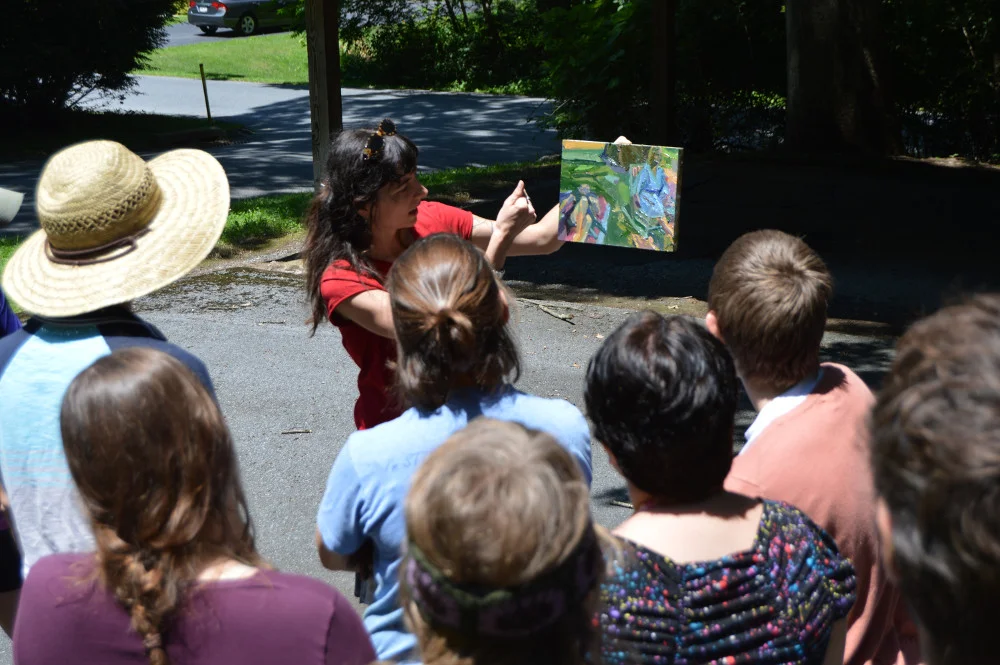
In addition to making work, we have been enriched each week by artist lectures from professionals across the country. In this week alone, we heard talks by Jeffery Reed, Sam King, and Stephanie Pierce—Monday, Tuesday and Wednesday, consecutively.
We finished our second week with our new lead painting instructor, Stephanie Pierce, and our fifth week of the overall "Intensive Program" here at Mount Gretna School of Art. Time is flying, as our paintings have grown larger and more ambitious. A devoted and hardworking mind-set grew among the group last week, week 4, as we stepped out from painting what we see in the landscape to painting what we imagined. Jay charged us to work large and make a painting from invention; “work inconveniently large; make a big inconvenient painting.” This challenge sparked nights of late night group painting in the studio, a frenzy we have carried into week 5. I am thrilled to be among a talented, hard working group of students, who work diligently morning, afternoon, and night. The devotion is contagious.
In addition to making work, we have been enriched each week by artist lectures from professionals across the country. In this week alone, we heard talks by Jeffery Reed, Sam King, and Stephanie Pierce—Monday, Tuesday and Wednesday, consecutively. Jeff Reed spoke Monday night after a group meal. He talked to us about the essential need in painting to convey pictorial ideas not "postcard scenes." His landscape paintings demonstrate a strong understanding of space, light, and atmosphere. He brought many of his paintings from his time in Ireland and also showed many scenes of rural Pennsylvania, a landscape we have become familiar with over the past 5 weeks. His works served as small windows capturing a fleeting atmosphere and light. He urged us to paint what we love, to make a connection to our subject, and to strive to paint evocatively instead literally.
The next night, Tuesday night, abstract painter Sam King shared with us his work and ideas. He began as a perceptual painter, painting landscapes in Indiana and Arkansas. His early work focused on the changes he observed in the landscapes surrounding him, such as the destruction of an old rail line and the building of a new road through a bird sanctuary. He has taken his perceptual sensibility and applied it to a new abstracted way of painting. He encouraged us to never stop searching for what it is we want to paint and what it is we want our paintings to say. He challenged us to take risks with our work. We should make work that causes us to ask the question, ‘is this good or is this dumb?’ “Learn to push your own buttons. Throw wrenches in familiar ways of painting and familiar ways of seeing.” One student asked how he decides when an abstract painting is finished, and he responded that his paintings are resolved when he still wants to be in the painting but there is nothing left to do. He is finished when the painting needs nothing more to keep him into it—advice I am trying to internalize this summer, as I wrestle with the struggle of knowing when a painting is complete.
Lastly, Stephanie Pierce gave a powerful artist talk during our Wednesday morning lecture series at the Hall of Philosophy in the Pennsylvania Chautauqua. She talked about her fight between representing the image of what she sees verses the experience of seeing. Her work is about movement and transience. Nature and light reveal itself to us in a "now-you-see-it, now-you-don’t" manner. This is also something the writer Annie Dillard heightened in awareness to this summer (we read her thoughts on “seeing” before starting our last three weeks of the summer with Stephanie). Stephanie’s paintings deeply connect with light’s movement across space and time. She spoke of seeing the rectangle of her paintings as a container of space holding restlessness. She confronts the fear of not knowing where the painting is going, an ideal that many painters, including myself, often hold on to tightly. Elements and moment in her paintings compete for importance and existence in the painting. She searches to find what matters to make it into the painting. Wisdom that has resonated in my head from Stephanie’s talk is her belief that painting can point to something outside of itself. Her paintings undeniably point to an experience of looking and the impossibility of capturing reality.
Space brings objects into being. by Mengdan (Mona) Shen (class of 2015)
"...So being in this painting program right after school has been such relief for me. I am finally out of theoretic art talk and am back to what I want and who I am. Nothing is any better than..."
I just interviewed for a job that should start right after the program ends in Lancaster, which excited me for a second, mostly because at least I know where I will be when this summer intensive painting session is over. But on my way driving back from this successful job interview the awareness of the program ending in two weeks made me miss Mount Gretna badly. And that’s when for the first time, I thought I liked and enjoyed being in this group much more than I had expected. Two months ago, I was still at art school, surrounded by critical thoughts to think of painting more as a concept. I struggled with whether I should choose painting as my language or not, but at the same time my defensiveness of form, against critics of form’s validity in art, persisted and sustained my interests in paintings.
Honestly art school is a community where all the smartest and dumbest people are, and, when you try to get through and figure out the concepts and theories (however meaningless they are sometimes), you will be more or less reflective on your own thoughts and work. But when people asked me about the feminism or psychology in my figurative paintings without really looking at them, and a professor who I still respect called my painting ‘academic’, I just wanted to walk away and paint without any explanation. I appreciate them truly responding to my work, but I trust my eyes more than any word. I accept painting as a form as it is. So being in this painting program right after school has been such relief for me. I am finally out of theoretic art talk and am back to what I want and who I am. Nothing is any better than improving through exchanges of thoughts with people who care about things as I do.
The first two weeks were very cheerful, while the third week was a lot more overwhelming and struggling. I think that this was after Brian Rego, who just left, showed us the impressive paintings he did with built-up surfaces, which led me to question the ways I naturally paint. I’ve been too comfortable with the way I paint and most paintings I did resulted in sameness. How anxious can you be when you find out that you have been missing possibilities? VERY. I was stuck in a situation where is no exit last week.
Monday was coming finally, with a new assignment by Jay. We were supposed to make a big painting without seeing directly from life, the subject could be anything or anywhere, as long as it made good sense on a painting. I didn’t get the point till I started. For me it’s perfect time to push the limit of one specific aspect and open up the possibilities of it. For example, what’s happening if a tree is composed structurally by lines only? - or a path is in the same tone as the sky but still reads as spatial due to slightly shifting temperatures in it? As a result I decided to give up the solid defining of form (at least not being so decisive about it at first), and apply the paint by many physical actions across the canvas. I began to see what paints and colors could do with space and environment if they are more open and not solidly formed into things. In other words, let the pieces of paint speak by themselves. It seemed a good start.
At the same time, I’m still trying to find a new and different position in which I find myself seeing and considering the things of so-called nature. I still cannot tell what my focus and intention is through making a painting, except to say that different points are happening all at once and I capture very little of them.
Some good conversations have happened. Once I brought up a question, ‘What if Cezanne were to paint something he’s actually not interested in, will it be a good work?’ Maggie King and I agreed on the conclusion that a good painter can paint everything well. She mentioned David Park’s sink painting as an example of something unimpressive that was painted well by a great painter (I’m searching for an image). Eventually both of us agreed that going through a process we sometimes hate and pushing through it, can actually lead us to somewhere good.
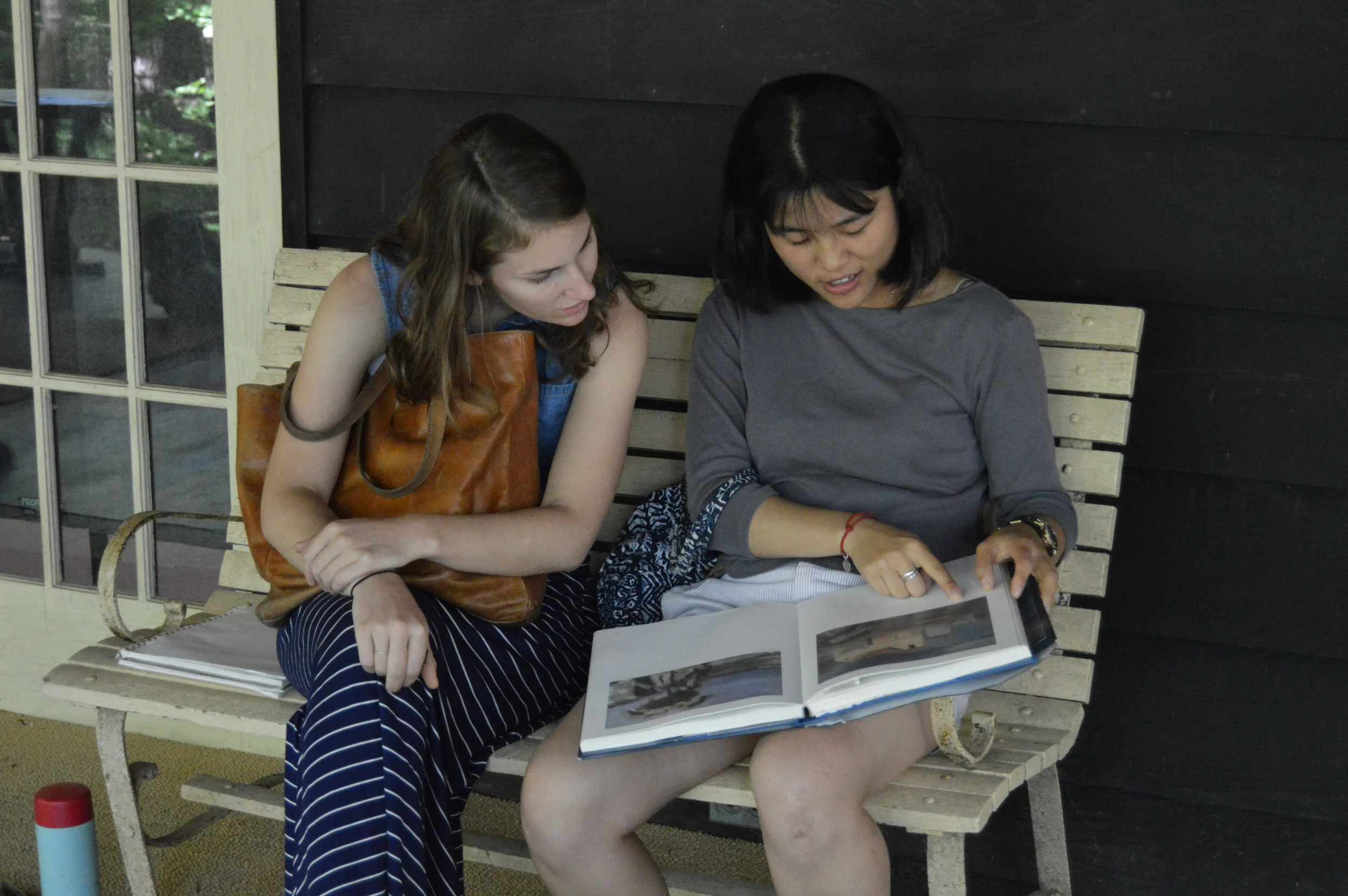
The most exciting thing that happened this week was the arrival of two new teachers, Stephanie Pierce and Mark Lewis. They both brought to mind thoughts that I have never taken seriously. Mark showed us his works and process in a lecture on Wednesday, and I confirmed that artwork is one of the best approaches to get to know a person. His passion for working on collages on-site is so impressive and inspiring. On Thursday morning, Stephanie had a lectured about the idea of finding the space in between objects by means of breaking the edge, deconstructing the solidity of form, and opening up the possibilities of color pallet. She emphasised the use of horizontal and vertical marks that pull around in space in an approach to treat everything in a painting equally. I’m very interested in her idea because it makes me think that space brings objects into being, and all we do is find the relationship through space as we truly respond to them. I saw the possibilities of how marks could create space as a unity with all the shifts responding to each other during her demo on Friday morning. She also showed us the media she’s using and how to organize it. On that painting day, I described the main areas of form as little as possible, and found the relationship by the light touch of overlapping color and merging edge.
My housemates have been working hard this week. Usually we aren’t back from the studio till midnight. Their small studies of still life always inspire me to work more.
On our way getting back from a museum trip to Philadelphia, I started to write down some thoughts that have never crossed my mind. First we went to the Barnes Foundation that has an intensive collection of modern paintings. I was already exhausted after walking around only the first of two floors! Cezanne intrigued me most as usual, but in different ways this time. He doesn’t necessarily paint light to bring you into a space, which I’ve been struggling with recently. The image is totally made calmly without the sense of time and emotion. He pulled out the essence of what’s always there by concise analysis of structure. So the whole image is glowing even though I cannot find any narrative light. The more I looked at his painting, the dark spots started floating around to hold up the space. His later works of rocks, trees and earth are the most ambitious.
When I was in high school, the first few painters that I liked were Maurice Utrillo and Amedeo Modigliani. I haven’t looked them up for a long time. When I walked into some rooms in the Barnes, I noticed their studies immediately among dozens of works on the wall. It felt like running into old friends that one can continue a good talk with.
The special Impressionist exhibition at PMA was interesting. Pissarro’s works are as good as always, so are Sisley’s early ones. Some painters are not the best, but I can see myself through them more. Monet’s Poplar Series is one of the best models on how to take one single element of landscape, explore the fleeting elements of light, weather or atmosphere.
I did three drawing studies from Cezanne in the PMA. There was no one in the circle room where his collections are for few minutes. Spending some time with him alone felt surreal.
Once we had looked at everyone’s drawings outside of PMA, everyone was finally exhausted after being exposed to so much art in one day. A group of us treated ourselves to a good dinner in a Chinese restaurant.
Sunday morning was coming with a burst of light on my bed. My goal in the upcoming week, the second to last week, is being as productive as possible.
Reflections on the Third Week. by Liam Corcoran (class of 2015)
I received an email from my grandmother who, knowing of my artistic expedition to Mount Gretna..., read the horoscope for Capricorn (my own): "Now is not the time for mild cautious, delicate turns of thought, but rather for vigorous meditations, rambunctious speculations and carefree musings." It seemed destined to be an eventful week...
Reflections on the Third Week
Monday began spontaneously. The second week's momentum continued over the weekend and built into excitement that was quietly shared by everyone as the third week began. If the weekend hadn't been there at all we wouldn't have minded nor noticed; the necessity of work flew right behind us as we entered the studio Saturday and Sunday, as it did 8:30 the following Monday morning. With the idea of Corot's abstract X's hidden in deep space (yes) to keep our faith primed, we painted in town and added wet media, painter's tape, and tracing paper to our repertoire in drawing class.
That night we had Chinese takeout, as we do every Monday for dinner, which once again brought me into contact with the object of my weekly dose of mysticism, the fortune cookie. My newest fortune as of Monday: "You will have good luck and overcome many hardships." It's times like these, away from home, holed up in relative isolation, that I find myself more apt to adopt pieces of wisdom from superstition. It's funny, later in the week I received an email from my grandmother who, knowing of my artistic expedition to Mount Gretna said she almost fell over in shock (!) when she read the horoscope for Capricorn (my own): "Now is not the time for mild cautious, delicate turns of thought, but rather for vigorous meditations, rambunctious speculations and carefree musings." It seemed destined to be an eventful week...
Tuesday brought a trip to the Union Canal Tunnel Park, a short drive from the studio, and another day of furious work. Wednesday was our lecture on Abstraction, Perception, Experience, and Landscape given by Carrie Patterson. Her talk, to me, reopened an idea with which I believe all of us have been struggling with in some respect, which deals with seeing abstraction in the subjects of our paintings. That is, not only seeing abstraction but accepting that it exists within the landscape, still life, portrait, of our interest and that we can only see it if we allow ourselves to let go of our preconceived notions of how objects exist within our field of vision.
With every step towards our goal of growing as artist we return to the essential truth in perceptual art: that we find truth when we paint faithfully what we see. If, through response to our visual experience we wind up with something that looks more like abstract shapes than the objects of our interest, we should trust that we are on the right track and that we don't need to pretty it up with preconceived ideas of how our objects should look.
This idea was echoed on Friday during critiques. Jay discussed the importance of being receptive to a diversity of color when responding to nature. He cited the Fauves, a group of artists in the early twentieth century famous (or infamous) for pushing color to its extremes. They used color right out of the tube. When they painted a warm color became a red, a cool became a blue and a value shift was indicated instead with a color shift. The result was a vibrant array of work that challenged present ideas concerning what colors could be used in which situations. The vibrant color use could be thought of as an abstraction from nature, and it is. The idea Jay conveyed to us during Friday critiques (relating intimately to Carrie's talk) is that the fauves did not merely use those colors because they were bright, but that they really saw those colors in the landscapes and figures they painted. This is how we should think about abstraction -- that it is the product of honest response during painting.
The momentum that had been building throughout the week stopped on Thursday. Instead of painting we devoted the morning to critiques. It was time for deconstruction (analysis). In sequence, each one of us hung our work, and allowed it to be subjected to the crude flailing remarks of our peers formulated with no regard to any preconceived verities that we may have formed in our own minds about our own work. These external voices are the real truths with which we must reconcile in order to grow. We must strive to remain open.
But the emotional smack down of Thursday wasn't over. The first of our venerated teachers to say his farewells that morning, Brian Rego, after giving us an eye into his own recent work, presiding over our critiques, and lending his final wisdoms, packed his supplies for his journey home. Brian, you will be missed. The afternoon brought our final drawing class. We all felt the drive to perform our very best that we might have a record of the great lengths we had come in just four sessions with the wonderful Catherine Drabkin. After dinner she too departed, leaving us only with an embrace and a lingering ghostlike voice within each of our heads imploring us all to remember to draw the feet too big..
Both teachers have been instrumental undoubtedly to our growth not merely in terms of technical skill in mixing color and handling charcoal but in our development as painters and drawers and the human beings that are attached to them. They encouraged us to acknowledge the difficulty of the work but also to think of our process as play and furthermore to appreciate with pride the poetic weight that our products convey.
Friday we had our critiques with Jay, and I struggled to make a few studies for future projects, but in the wake of critiques and the exodus of our mentors, Friday seemed a confusing time. I went to bed early. Today is Saturday, the fourth of July -- a fitting way to end an explosive week (ha-ha). I didn't work on my paintings or even draw today. I couldn't. My housemate said it felt like there were too many voices to interpret to really get any meaningful work done. I understood that; with the critiques so close behind I felt I needed to do some serious reflection before I could start making any tangible progress again. John Marin said "Beware of the ambitious one and the one who works all the time -- he hasn't time to think." I needed time to think! And so I suppose it was a gift that I had been given the "writer" task create the student blog post for the week. It justified my taking the day to process the most recent events. So I took a walk around the lake, I explored some more of Mount Gretna, saw a really big snake, I called my father. In a journal I wrote some notes down about what I thought had been the most important parts of this week, and later I used a lot of them to make this blog post.
We had a big dinner at Boehm cottage tonight. There were sparks and smoke as we watched some neighbors light fireworks. Though I felt that we were all in some degree exhausted by the culmination of the momentum that we had been building since we arrived at Mount Gretna, there was also a pervasive energy and excitement for the incoming teachers and work in store. Tomorrow marks the half way point of the program, a day to take stock of supplies, prime canvasses, and make studies to hit the ground running on Monday with the start of a new momentum aimed always towards higher states of observation, of further growth, and of sustained reflection.
Work and sense of family. by Emily Arndt (class of 2015)
...Besides sharing different art techniques throughout our daily critiques, these artists have shared interesting things that have happened during their painting sessions throughout the day to more personal things such as unforgettable stories that have made me laugh and cry. I feel strongly that these people are more than just art students they are a small group of people I can call family.
Mount Gretna is an inspiring and unique place that brings dedicated students from different parts of the country together. While at Mount Gretna, talented and professional staff have helped me achieve many goals by challenging me to further explore and develop my artistic skills and techniques. I have become more knowledgeable and passionate about my overall artistic painting and drawing process. In order to create a successful painting or drawing of a landscape, I knew that I needed to immerse myself in a program that is committed to training individuals who are serious about making art.
I have never made a more wise decision than the one I made when I chose to attend the Landscape Painting Program offered at Mount Gretna. While at Mount Gretna, I’ve had the pleasure of meeting many new people with different backgrounds. These students, and I have created many new and unforgettable memories and have become friends. Besides sharing different art techniques throughout our daily critiques, these artists have shared interesting things that have happened during their painting sessions throughout the day to more personal things such as unforgettable stories that have made me laugh and cry. I feel strongly that these people are more than just art students they are a small group of people I can call family.
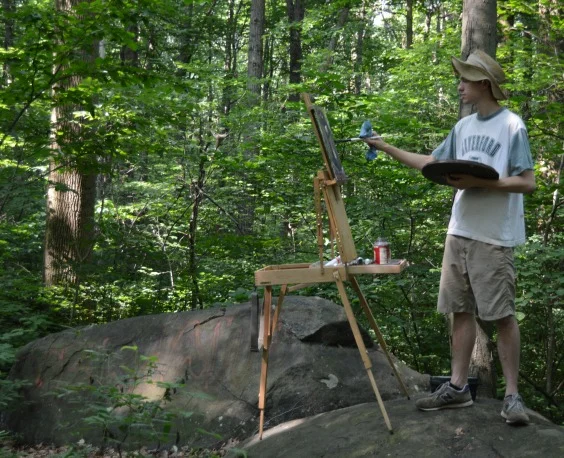
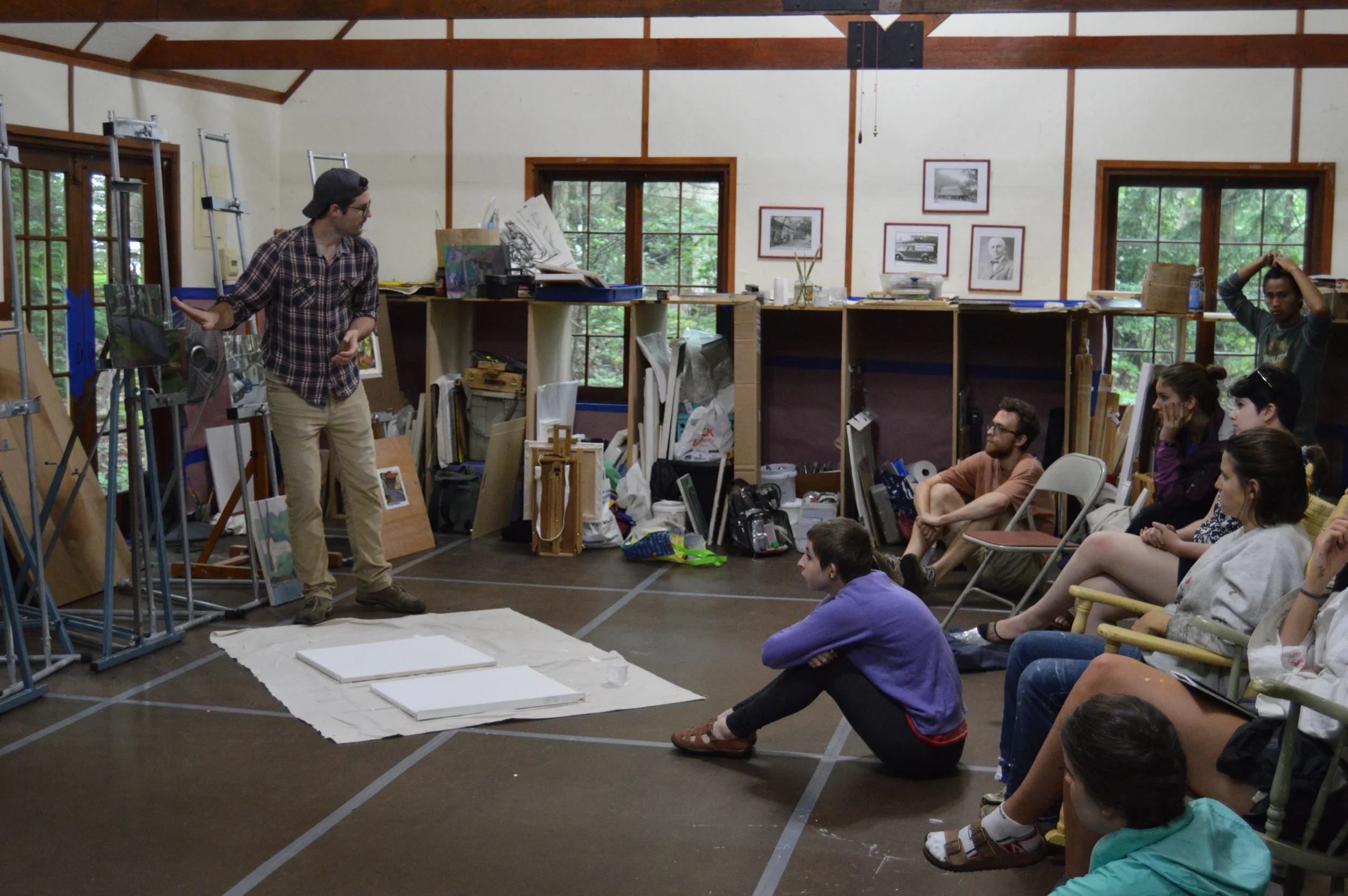
My art friends and I often spend our time painting on location around our studio in the woods where we paint our landscapes and occasionally work on self-portraits. We also enjoy venturing off to other areas of Mount Gretna that are easier to get to by car. When travelling to these destinations during our free time, our group often makes small stops to local farmers markets and other places such as the local art supply stores. During car rides on our way back to the studio, our group often share jokes and tells stories about our families and friends at home. My new friends are always considerate about what it is that I have to say and always make me feel welcome. During the week after a day of work at the studio, we sometimes go out for a meal together to the local pizza shop, or gather together on one of the cottage porches and share dinner with faculty and visiting artist. After dinner and before resuming work, we often play board games or card games for fun.
Our cottages are small quaint places that make a person feel at home. Every necessity I need is always there thanks to the support of my cottage leader. My favorite area of the cottage I stay in which is known as the Markwood cottage, is our kitchen and dinning room area. Here I am able to have a sit down breakfast and dinner with the people I live with. We often joke about who will have the last cup of coffee and discuss artists we know.
Our classes during the day are run by hardworking staff who make learning more enjoyable and keep their students their first priority. My teachers always provide us with new material that helps to strengthen our learning experience. My teachers also provide me with new problem solving solutions that allow me to view the world I paint around me from a different perspective. It is during these lessons that I am able to break what I see down into different shapes, colors, and values. While in my drawing class, I learn how to properly draw an object’s proportions by sighting what I see. Over class breaks the other students and I often gather on the porch and read books on famous or popular artists. Other times during my break, I find myself sketching the beautiful landscape around me. Mount Gretna is a wonderful place, with wonderful people that continuously inspire the work that I make.
That Particular Green. by Elizabeth Flood (class of 2014)
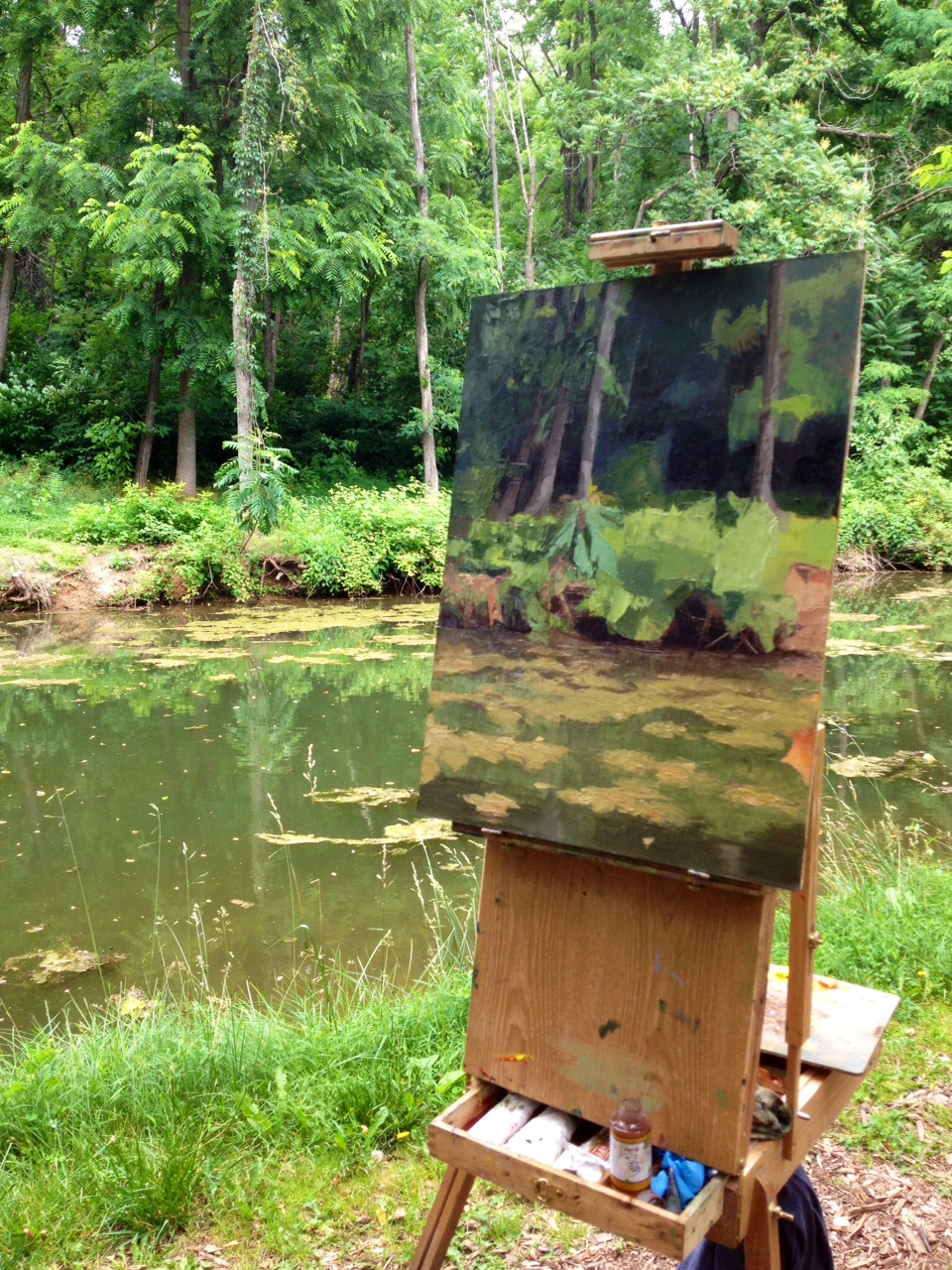
Pablo Picasso once said, “They’ll sell you thousands of greens. Veronese green and emerald green and cadmium green and any sort of green you like, but that particular green, never.” I have developed a love hate relationship with the color green during my time at Mount Gretna—constantly grasping for that particular green in the particular light of a particular instant in time. For the first week or two that I was here, I was so caught up in mixing exactly the green that I saw, but it became clear to me very quickly that it is nearly impossible to paint exactly what you see As I tried to grapple with creating space and variety among a dense patch of trees, our first painting instructor Martha Armstrong told me something that I will never forget. To paraphrase, she said that you can’t always paint exactly what you see in order to paint what you see. The more I’ve painted here, the more Martha’s words of wisdom have really sunk in. Upon a first glance into the woods, or across a field, everything looks green, but as artists, we develop a unique language of line, color and value that expresses the world however we see and feel it. Our current painting instructor Xico Greenwald constantly encourages us to paint in a way that feels authentic. Like Martha’s advice, I’ll certainly keep Xico’s guidance in the back of my mind while painting.
On July 4th, we had a show displaying the work we’ve made throughout the summer. When I walked around to look at everyone’s work it dawned on me: not one of these paintings has the exact same green in it. Every one of us has learned to embrace our own artistic language through painting, whether its expressive and chaotic marks or more structured blocks of color, there is no one particular way to paint, no predetermined shade of green. Picasso’s “particular green” is different in every one of our paintings, and that to me is just awesome. I’ve learned so much here, and made so many fantastic friends. Although I’m sad that my time at MGSoA is coming to a close, I’m so excited to take everything I’ve learned here, continue to develop my own artistic voice, and carry on my wrestling match with the color green wherever I end up.
Landscapes, as a subject, engulf us. By Adam Campbell (class of 2014)
What is essential is the love we give to what we are attracted to in the landscape. Seeing is a deliberate act of caring about what I’m looking at. It operates just beneath the intellect and arouses a feeling of excitement to share my perception of the world...
It seems that all great artists spend some time in their careers painting landscapes. As a subject, it engulfs us. Our instructors have told us to ask ourselves “what is essential?”, to come up with a system of shorthand, to look for the planar structure and see interlocking shapes of warm and cool colors. The landscape still overwhelms. Every scene presents a different set of problems. Landscape painting holds the keys to understanding light, abstraction, and the necessity of immediate action. In some way, landscape painting is a practice of religious devotion, if art were such a thing.

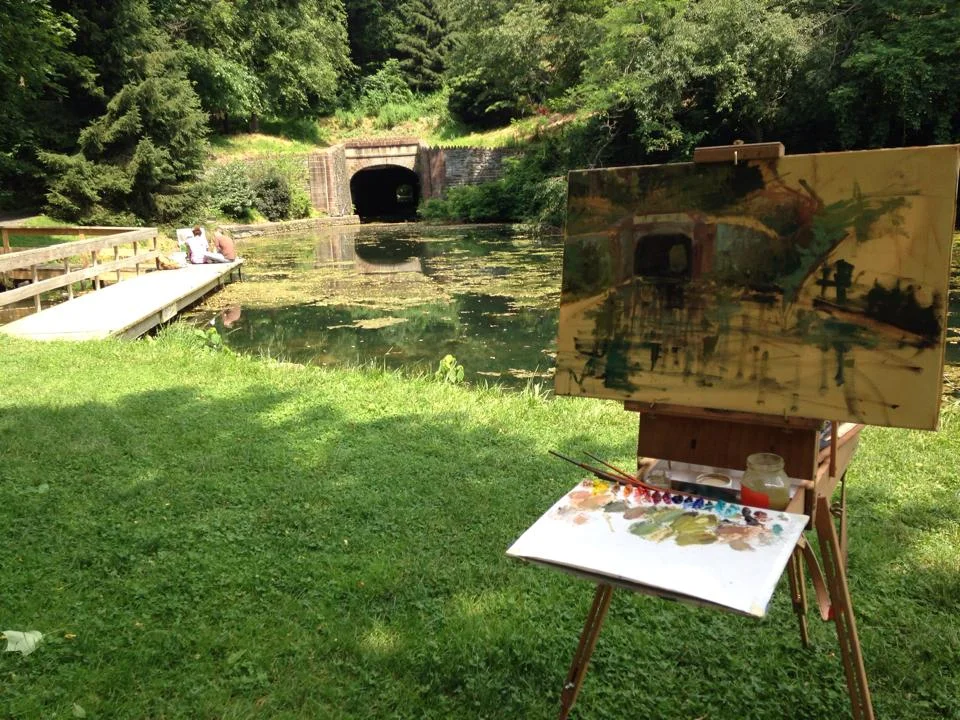
Union Canal Park, Lebanon PA
Last week we received our new painting instructor, Xico Greenwald. His advice has broken me of some bad habits and also helped me understand how to answer the question posed by our previous drawing instructor, Brian Kreydatus. What is essential is the love we give to what we are attracted to in the landscape. Seeing is a deliberate act of caring about what I’m looking at. It operates just beneath the intellect and arouses a feeling of excitement to share my perception of the world.
As we enter the last two weeks of our time at Mount Gretna, I’m excited by the prospect of being able to communicate, through paint, the beautiful things I see in nature. It is mind-boggling how complex the simplest things are when looked at carefully. And inspiring how beautifully mundane things become when we pay close attention to them.
Chasing the light, By Natalie Brown (class of 2014)
Week three began with an ambush. I believe that it was part of a strategic plan. Right when most of us had begun to get our bearings with landscape painting, we were exposed to some incredible artists and instructors who made it impossible for us to get comfortable or lazy...
Week three began with an ambush. I believe that it was part of a strategic plan. Right when most of us had begun to get our bearings with landscape painting, we were exposed to some incredible artists and instructors who made it impossible for us to get comfortable or lazy with perceptual painting and drawing. Thanks to Ken Kewley, Deborah Kahn, and Lynette Lombard, my comrades and I have no illusions—this is an uphill battle.

Maybe I should abandon the war metaphor. The treachery we experience here is limited to bug bites and sunburns, both due to our own failings to prepare our bodies in addition to our painting materials each day. We are enjoying lovely weather and painting (and drawing) our way to the blissful psychological state of really seeing. Get up, have breakfast, paint for several hours, critique, take lunch, and then draw and/or resume painting. Then we have an elaborate and delicious dinner as a group (like the multi-course Italian dinner we had Wednesday night), and finally go work until it’s time to sleep. We’re here because we are the kind of peculiar people who want nothing but to study, make, and talk about art, and so really this is our utopian society. It is a perfect balance of the relentless artistic pursuit and optimal living conditions. What we’ve been reminded of this week, though, is that we love art because of the perpetual challenge, and therein lies the battle.
Capturing what I perceive is not the end goal; it is one of many components to making real art. The artists who graced us this week demonstrated the importance of controlling, manipulating, and sometimes taking lightly what we embrace as subject matter. These artists don’t produce realistic images, but work that requires a more active role for the artisit. Ken Kewley’s lecture and workshop last weekend taught us to distill visual information by working quickly with a laissez faire attitude toward image and product. In his workshop, students drew quickly and simply from perception to create compositions with abstract priorities. We then quickly made swatches of color observed from the landscape and figures, and collaged them into drawings back in the studio to synthesize what we had observed from multiple viewpoints. It was a stark contrast to the intense and scrupulous approach to looking that we’d been taught by our first drawing instructor, Brian Kreydatus, but with the same goal of capturing what is truly important.
Ken taught us that working from perception does not necessarily mean painting something that you observe simultaneously. He introduced to us the dimension of time. With trained eyes, we come to remember what’s important, and in the studio that can be balanced with formal interests that serve each piece as a work of its own. Deborah Kahn then expanded upon that theme of working perceptually with the filters of time and memory. She describes her own work as perceptual, but based primarily on what she perceives in her work in progress, and informed secondarily by her understanding of visual perception of the world. I was amazed to hear perceptual painting defined in this way—the important perception is not only of subject matter, but of the created image. Drawing and painting can be reactive, fluid, and alive on the paper or canvas. Composition and emphasis are not fixed from the start, but should be found through the application of marks on a surface.
Inspired by our guest lecturers, I did some experimenting, but failed to find methods to execute the artistic control I wanted over my drawings and paintings. Fortunately, Lynette Lombard entered in as our new drawing teacher just in time to enlighten us on how to take the reins. I just want to say right now, Lynette’s drawing classes are absolute magic. Four hours with her flies by, and leaves me wondering how I survived without the new things she had just taught. Her classes begin normally enough with drawing models and the studio as we see them, but then we are introduced to axes, alignments, and wealth of other tools for controlling our drawings, and implement these upon what has already been drawn. We edit and adjust continuously, even during critique (brilliant!). And then we all have to be herded off to dinner, for though we are starving after a long studio day, we are on fire and want to keep going with our drawings.
I can’t express the kind of overwhelming excitement this week has provided. On the one hand, I’ve seen artists whose work seems so far from where I am. I’m dying to reach that territory, and know that the only way to get there is to work constantly. It’s all I want to do. I don’t want to stop to eat or sleep (I don’t care how nice and cute my new cottage is). I want to work until my paintbrushes and I fall apart beyond use. Right when I felt I was getting a grasp of color, space, and movement, I was reminded of the elements of imagination and feeling. Rather, I wasn’t reminded, but allowed and encouraged to let those things matter again. I’m getting a good enough grasp now of the straightforward technical aspects of image-making to let impression and emotion play roles, and I don’t know what could be more motivating than that.
Structure is key, to art, and to life. by Paige Stewart (class of 2014)
I've been at Mount Gretna for about two weeks now and I've never felt more confident that I have been on the right path. I'm at a point in my life where my enthusiasm for art matches my intensity of creating and it's bringing me a feeling of personal achievement. I'm not afraid to make failed paintings because...
by Paige Stewart, class of 2014
I've been at Mount Gretna for about two weeks now and I've never felt more confident that I have been on the right path. I'm at a point in my life where my enthusiasm for art matches my intensity of creating and it's bringing me a feeling of personal achievement. I'm not afraid to make failed paintings because I realize that failures are part of the learning process and will ultimately bring about a successful piece. I'm learning that there is no right way to paint, which is very liberating and brings me more freedom in my process. The voices that have continually haunted my practice, by constantly telling me "this is the the way painting should be done", are disappearing and i'm rediscovering a way of painting that simply works better for me. I'm finding the value in working in repetition and multiples while painting, drawing, and studying an object. Martha Armstrong has said "why would you move on quickly from a subject when you're just beginning to learn it." I'm paraphrasing of course.

Martha Armstrong conducting a critique of the day's work.
As I'm discovering a process that works for me, I have also been encouraged and reminded by Chris Dolan to be scientific, yet childlike, and keep playing in my artworks that focus on the same subject. He has given me the very helpful advice that if working in multiples, it can only be helpful to make small changes in each painting, as a way to see and know if that certain change works or not. By doing so you will understand what exactly was the success or failure of the painting and what made it captivating or disengaging. What amazing and helpful advise, as I would usually try too many different changes at once and then be confused to what worked and failed.
Bryan Kreydatus has brought a great deal of knowledge to this program and I'm envious that I can't work with him longer. He helped me rediscover looking and I mean really looking, by only seeing what's essential. I never realized how much of my drawing and paintings have become made up, created on assumptions and quick tricks I have developed for myself, habits that needed to be broken.
"Make the familiar unfamiliar by the intense act of looking" - Bonnard

Brian Kreydatus teaching a mono print session from the model.
I am continually reminded by all three of these artist how important it is to study the old masters, draw from them, steal from them, learn from them. I have also have learned of how color is relative. I have always been taught this and thought I understood, but I have just recently made a connection to what those words really mean. I can not just mix what colors I think I see on my pallet, then expect them to read the same way when placed next to another color on the canvas. If there's a really saturated color that can not be mixed, I may have to put a muted color beside it. If I need a light area, I may have to darken the other colors to give that illusion. If I have a color in the background, say green, I can't have that same green in the middle or foreground and still have the same space and structure. Everything I have needed to hear for the past two years since college, has been said and has been understood.
Not only have the teachers and my peers been of great importance to me, but the way this program has been structured has promoted a work habit in me that I needed to be exposed to. Jay Noble has done an outstanding job with the structure of this program and it is by far one of the most important parts of my experience. We have two eight hour in class work days, two four hour in class work days, and then a lecture day, with the rest being independent study. This schedule is so helpful to me. The eight hour in class days are the core structure and foundation to what my work ethic should be. The four hour in class/lecture days get me up and moving early, keeping me from distractions, while also setting the pace for the rest of my independent study. In between class, we have lunch and dinner breaks, which are also of importance because they are like scheduled relax time off. We are busy from the time we wake up to the time we're too physically and mentally tired to do any more work. I have never been in a program as well structured and intense as this one and I will try my hardest to bring this structure into my practice after this residency because I feel it is the biggest foundation to creating, learning, and growing. I have learned more in the last two weeks then I have in the last two years and I'm really excited to use all this knowledge to develop as an artist.
I could go on and on about this program, everything I have mentioned so far was only a little slice of heaven. I could create an entire series of blogs about how welcoming and supporting the Mount Gretna community is, the New York trip to see galleries and the met, and the weekly artist talks, but I think i'm going to conclude that I highly recommend his program and I hope I get a chance to come back next year.
Student Blog
This blog features posts by students of the intensive program. Reflections on events, activities, and learning. "Writer" is a work-study job. Editing and oversight of these posts by the Mount Gretna School of Art is kept to a minimum out of respect for the authenticity of the student voice. The views and opinions expressed may or may not reflect the views and opinions of MGSoA.
Latest and Greatest:

“(Before MGSoA) I had no fun (drawing) …it was no surprise that I wasn’t excited about the drawing class. Not especially after Barbara Grossman walked into our studio space, wrangled around with the easels twice her height, and proclaimed that “[she] will push [us] to [our] limits for the next two weeks to come… now I get it.”
